How to Choose a Fruit Jelly Manufacturer in India: B2B Buyer Guide 2026
Choosing the right fruit jelly manufacturer in India can make or break your distribution business. This guide covers the key evaluation criteria — from production capacity and certifications to MOQ flexibility, pricing models, and private label support.
India's confectionery market is growing fast. According to industry reports, the Indian confectionery segment is expected to grow at over 8% CAGR through 2028, and fruit jelly products are among the fastest-growing subcategories. For distributors, wholesalers, and private label brands, finding the right fruit jelly manufacturer is the first and most important decision.
But with hundreds of jelly manufacturers listed on platforms like IndiaMART and TradeIndia, how do you separate the reliable partners from the risky ones? This guide gives you a structured evaluation framework for choosing a fruit jelly manufacturing partner in India.
Why Manufacturer Selection Matters
The manufacturer you choose directly impacts every aspect of your business. Product quality determines your customer retention rate. Production capacity determines whether you can fulfill orders during peak season. Pricing structure determines your margins. And compliance certifications determine whether you can sell in organized retail and export markets.
A poor manufacturer choice does not just mean bad product — it means returns, customer complaints, lost retail shelf space, and damaged business reputation. Taking the time to properly evaluate manufacturers upfront saves significant cost and headaches later.
8 Criteria for Evaluating a Fruit Jelly Manufacturer
1. Production Capacity and Reliability
The first question to ask any manufacturer: what is your daily production capacity, and can you scale during peak demand periods?
During festival seasons (Diwali, Holi, Raksha Bandhan) and summer months, confectionery demand in India can spike by 40-60%. Your manufacturer must have the capacity to handle these surges without compromising delivery timelines or product quality.
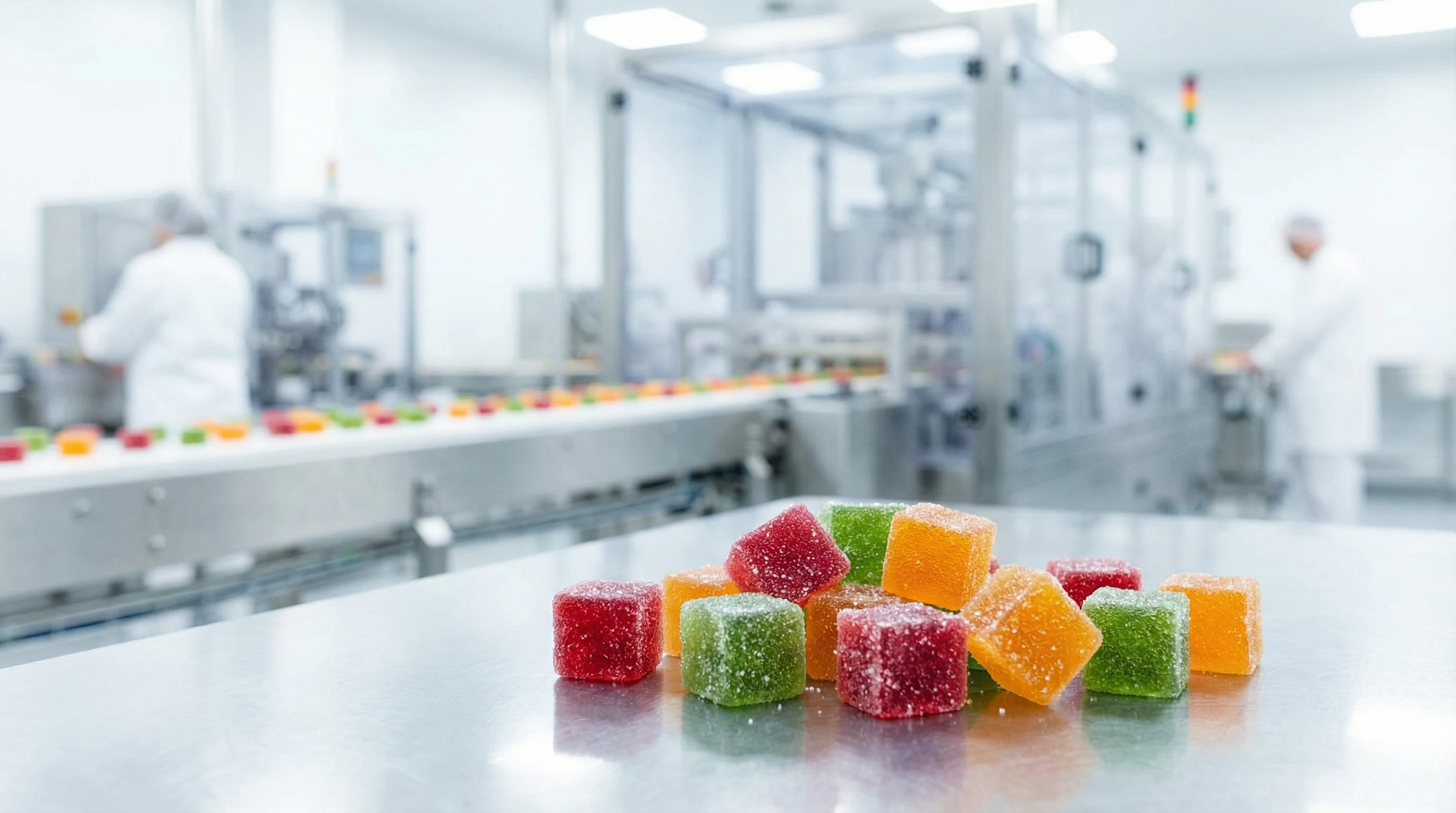
Look for manufacturers with automated production lines rather than purely manual operations. Automation ensures consistent cube size, uniform sugar coating, and predictable output volumes. Fruitlly by Tulsi Foods, for example, operates automated lines with a capacity of 50,000+ units daily from their MIDC Jalgaon facility.
2. Ingredient Quality and Sourcing
Ask your manufacturer about their ingredient sourcing — specifically for sugar, pectin, fruit flavoring, and food colors.
Key questions to ask: Do you use fruit pectin or gelatin as the gelling agent? Where is your pectin sourced from? Do you use actual fruit pulp or only artificial flavoring? Are your food colors FSSAI-approved? Do you have a documented supplier qualification process?
The answers to these questions directly impact the taste, texture, and vegetarian status of the final product — all of which matter to Indian consumers.
3. FSSAI License and Food Safety Compliance
Every food manufacturer in India must hold a valid FSSAI (Food Safety and Standards Authority of India) license. This is non-negotiable. Without it, you cannot legally sell food products in India.
Beyond the basic FSSAI license, look for manufacturers who follow Good Manufacturing Practices (GMP). Advanced manufacturers may also hold certifications like ISO 22000 (food safety management systems) or BRC (British Retail Consortium) certification for export-grade production.
Ask to see the manufacturer's FSSAI license number and verify it on the FSSAI website. Also check whether the license covers the specific product categories you need (confectionery, jelly, fruit-based products).
4. Shelf Life and Quality Consistency
A quality fruit jelly manufacturer should guarantee a minimum shelf life of 9-12 months for sugar coated jelly cubes under proper storage conditions.
Request shelf life test reports and ask about accelerated stability testing. The key parameters to check include: moisture content (must be controlled to prevent coating dissolution), texture firmness over time, color stability (no fading), and microbiological safety.
Batch-to-batch consistency is equally important. Ask the manufacturer what quality control checkpoints they use during production. A reliable manufacturer will have documented QC procedures for every stage — from raw material inspection through final packaging.
5. Minimum Order Quantity (MOQ) and Pricing
MOQ requirements vary significantly across manufacturers. Some require minimum orders of 500kg or more, which is impractical for new distributors or test orders. Others offer more flexible entry points.
The ideal manufacturer for a growing distribution business offers tiered MOQ options: a small initial order for product testing, a standard MOQ for regular supply, and volume pricing for large orders.
Ask about the complete pricing structure including: per-kg or per-unit cost, packaging cost (if separate), transportation cost (FOB vs delivered pricing), and payment terms (advance, COD, or credit terms for established accounts).
6. Product Range and Flavor Options
A manufacturer with a broad product range gives you more options for market expansion without switching suppliers.
Beyond standard sugar coated jelly cubes, check whether the manufacturer also produces: fruit jelly cups, jelly bars and rolls, imli (tamarind) jelly products, fruit jams and crushes, and other confectionery items. A diversified manufacturer is also more likely to have robust R&D capabilities for developing custom flavors and products.
7. Private Label and Custom Branding Support
If you plan to build your own brand (rather than distributing under the manufacturer's brand), private label support becomes critical.
Key private label capabilities to evaluate: Can they print your brand on packaging? Do they offer custom packaging design services? What is the minimum order for private label production? Can they develop custom flavors exclusive to your brand? Will they maintain confidentiality on your product formulations?
Tulsi Foods (Fruitlly) offers complete private label manufacturing services, from product development through custom packaging, with flexible MOQ for qualified brand partners.
8. Factory Visit and Reference Checks
Never finalize a manufacturer relationship without visiting the factory. A factory visit reveals things that no catalog or website can show: the actual hygiene conditions on the production floor, the condition and age of machinery, the organization and cleanliness of storage areas, the professionalism and training level of staff, and the real production capacity versus claimed capacity.
Also ask the manufacturer for 2-3 existing distributor references. Call these references and ask about: on-time delivery track record, how they handle quality complaints, how quickly they respond to urgent orders, and whether they have increased prices unexpectedly.
Red Flags to Watch For
Be cautious of manufacturers who display any of these warning signs: no FSSAI license or an expired one, reluctance to allow factory visits, no batch testing or quality certificates, extremely low pricing that seems too good to be true (usually indicates inferior ingredients), no proper invoicing or GST billing, inconsistent product quality between sample and bulk orders, and unrealistic shelf life claims (over 18 months for sugar coated jelly cubes is suspect).
Why Distributors Choose Fruitlly by Tulsi Foods
Tulsi Foods has been manufacturing fruit jelly products from Jalgaon, Maharashtra since 1995. The company operates under the Fruitlly brand with the following advantages for B2B partners:
Manufacturing Experience: Over 30 years in confectionery production. This is not a startup or a new entrant — it is an established manufacturer with deep process knowledge.
Automated Production: Modern production lines at the MIDC Jalgaon facility ensure consistent product quality and reliable supply capacity.
Complete Product Range: Sugar coated jelly cubes, fruit jelly cups, jelly bars, imli candy, fruit jams, fruit crush, and syrups — all from a single manufacturing partner.
Flexible Partnership Models: Whether you want to distribute the Fruitlly brand, create your own private label brand, or source in bulk for repackaging, Tulsi Foods supports all three models.
GSTIN Verified: Fully compliant with GST requirements (GSTIN: 27AANFT0134D1ZF). Proper invoicing and documentation for all business transactions.
Proven Track Record: Products already distributed across India and available on major marketplace platforms including Flipkart and IndiaMART.
Next Steps for Interested Buyers
If you are evaluating fruit jelly manufacturers for your distribution or private label business, here is what to do next:
Visit the Fruitlly product catalog at https://fruitlly.com/products to see the full range.
Contact our B2B sales team at +91 94222 83890 or email info@fruitlly.com with your requirements.
Request product samples (available for qualified business inquiries).
Schedule a factory visit at our MIDC Jalgaon facility to see production firsthand.
Discuss pricing, MOQ, and partnership terms with our sales team.
We respond to all B2B inquiries within 24 hours.